🕷️ Cicada Choruses Why Some Summers Are Louder
🧾 Quick Facts
Cicada choruses, renowned for their unique and sometimes deafening sounds, can often vary in volume depending on regional circumstances and environmental conditions. Here are some quick facts:
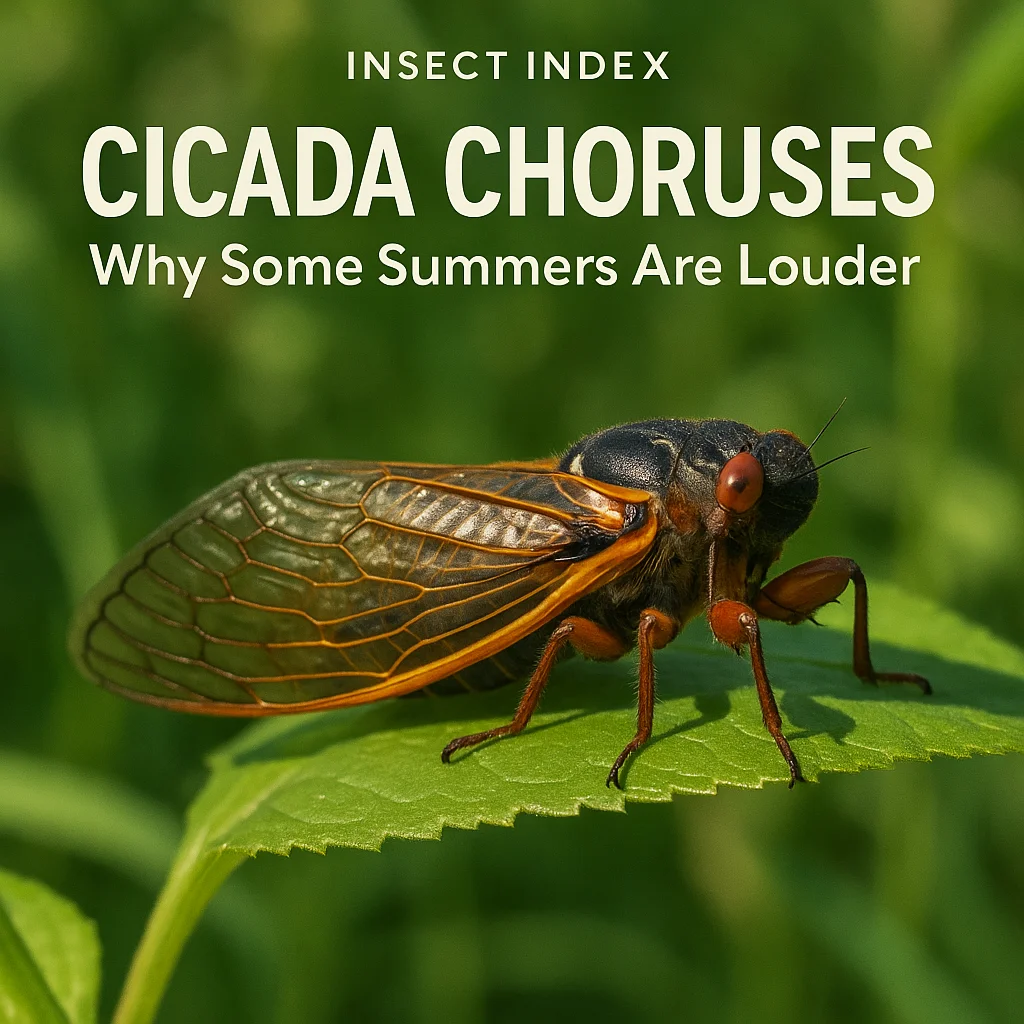
- Common names: Cicada, Locust (though not a true locust)
- Scientific name: Varies (multiple species)
- Insect: Yes, it is an invertebrate
- Order / family: Hemiptera / Cicadidae
- Typical size range: 2 to 5 cm in length
- Key colors/patterns: Often green, brown, or black with translucent wings
- Activity: Primarily diurnal (active during the day)
- Typical habitats: Woodlands, forests, urban gardens
- Where in the world: Temperate regions worldwide
- Seasonality: Summer (varies by region)
🔍 Identification
Cicadas are relatively easy to identify due to their distinct body shape and sound-producing capabilities. They have a robust, elongated body with a broad head and two large, prominent eyes set wide apart. Their transparent wings are often held tent-like over their backside.
- Body is wedge-shaped, tapering from head to abdomen
- Long and thin antennae
- Large, clear wings with visible veins
- Strong legs adapted for clinging to trees and shrubs
- May be confused with grasshoppers, but cicadas have much shorter legs
- Top ID Tips:
- Look for large, visible eyes
- Listen for distinctive, loud songs
- Transparent wings with intricate vein patterns
- Presence on tree trunks and branches
- Drab wing color that blends with tree bark
- Broad head compared to body
- Noticeable tymbals on the abdomen
🧠 Basic Body Structure
Cicadas are insects characterized by a body divided into three main segments: the head, thorax, and abdomen. They have six legs and a tough exoskeleton. As invertebrates, cicadas lack a backbone, relying on their exoskeleton for support and protection. They undergo molting as they grow and develop wings to become strong fliers.
🌍 Habitat & Distribution
Cicadas thrive in a variety of habitats such as woodlands, temperate forests, and even urban gardens. They are most commonly found in regions with abundant foliage and trees, as they rely on plant tissues for feeding and laying eggs. Cicadas are widespread across North America, Australia, and parts of Asia. Regional climate variations influence sightings and abundances, with favorable conditions enhancing their presence.
📅 Seasonal Appearance & Activity
Cicadas are most visible during the warm summer months, though their appearance may vary depending on species and localized climates. Predominantly active during the day, they are often seen clinging to tree bark or foliage where they create their distinctive calls.
- Best Time to Spot It:
- Late spring to early summer
- Warm, sunny days
- After rainfall
- From mid-morning to late afternoon
🥚 Reproduction & Egg-Laying
Cicadas are known for their unique courtship songs, which males produce to attract females. After mating, females lay eggs in plant stems or woody branches. Depending on the species, cicadas can lay hundreds of eggs at a time. Egg-laying strategies and egg counts vary widely among different cicada species.
🌀 Metamorphosis & Life Cycle
Cicadas undergo incomplete metamorphosis, consisting of three life stages: egg, nymph, and adult.
Egg Stage: After eggs are laid in plant tissues, they hatch into nymphs. This stage can last several weeks depending on environmental conditions.
Nymph Stage: Nymphs drop to the ground and burrow below the surface, where they feed on plant roots. This stage can last from a few months to 17 years in certain species, with environmental variables affecting duration.
Adult Stage: After emerging from the ground, nymphs molt into adults and leave their exuviae (molted exoskeleton) behind. Adults are primarily active for a few weeks before reproducing and concluding their life cycle.
🍽️ Diet & Feeding Behavior
Throughout their life stages, cicadas primarily feed on plant sap using their specialized piercing-sucking mouthparts. While nymphs rely on underground plant roots, adults feed on tree vascular tissues. This feeding behavior categorizes them as herbivores, influencing the plant physiologies around them.
🦉 Predators & Defense
Cicadas have a range of natural enemies, including birds, reptiles, amphibians, spiders, and certain mammals. To protect themselves, cicadas often utilize camouflaged coloration to blend into their surroundings and startle predators away with their sudden emergence flights and sounds.
- Defense Highlights:
- Camouflage with tree bark
- Sudden flight to escape attacks
- Use of loud, unsettling noise
- Group emergence overwhelms predators
👥 Social Behavior & Swarms
Cicadas can be solitary or form relaxed aggregations for breeding purposes. Noteworthy among certain species are periodical mass emergences triggered by synchronized development driven by climatic cues and temperature changes. These swarms increase their chances of survival against predation.
🧭 Senses & Communication
Cicadas are well-equipped with senses for interacting with their environment. They have developed vision for spotting movement and rely heavily on sound. Males produce loud, rhythmic songs to attract mates using specialized structures called tymbals. These songs form part of their communication system, helping discern suitable partners and deter rivals.
🌱 Role in the Ecosystem
Ecologically, cicadas play significant roles in nutrient cycling and ecosystem dynamics. As herbivores, they help regulate plant populations, while their decaying bodies enrich soil nutrients upon their death. Predators depend on emergent adult cicadas as a food source, making them integral to food webs. Additionally, they influence plant diversity and health through their feeding activities.
📉 Population & Conservation Notes
Cicada populations are generally abundant, with periodic cycles enhancing reproductive success. However, habitat destruction, pesticide application, and climate change pose threats to certain species. Conservation efforts often emphasize habitat retention and minimizing pesticide usage.
- How to Help (Low-Impact):
- Preserve native plant species
- Avoid unnecessary pesticide usage
- Maintain tree health in urban areas
- Support habitat restoration initiatives
⚠️ Human Interaction & Safety
Cicadas do not bite or sting humans and are generally harmless. Observing them respectfully is encouraged, and wild specimens should be left undisturbed in their natural environment. If allergies or irritation occur during interaction, clean the contact area with water and seek professional aid if symptoms persist.
📌 Summary
- Cicadas are easily identifiable insects due to their sound and appearance.
- Commonly found in wooded areas and urban gardens during summer.
- Lifecycle spans egg, nymph, and adult stages, with varying durations.
- Herbivorous diet primarily consists of plant sap.
- Natural defenses include camouflage and loud sounds.
- Swarming behaviors driven by environmental synchrony.
- Contribute significantly to nutrient cycling and ecological balance.
- Preserving habitats and responsible pesticide usage benefit their populations.
- Harmless to humans but should be observed with consideration.