🕷️ Cicada myths: “they sting” (false)
🧾 Quick Facts
The cicada is a fascinating insect shrouded in myths, including the false belief that they sting. This profile explores the intriguing life of cicadas and dispels common misconceptions.
- Common names: Cicada
- Scientific name: Varies
- Insect: Yes, invertebrate
- Order / Family: Hemiptera / Cicadidae
- Typical size range: 1 to 2.4 inches (2.5 to 6 cm) in length
- Key colors/patterns: Green, brown, black; clear wings with prominent veins
- Activity: Primarily diurnal
- Typical habitats: Woodlands, gardens, orchards, and urban areas
- Where in the world it occurs: Found on all continents except Antarctica
- Seasonality: Most visible during late spring to late summer
🔍 Identification
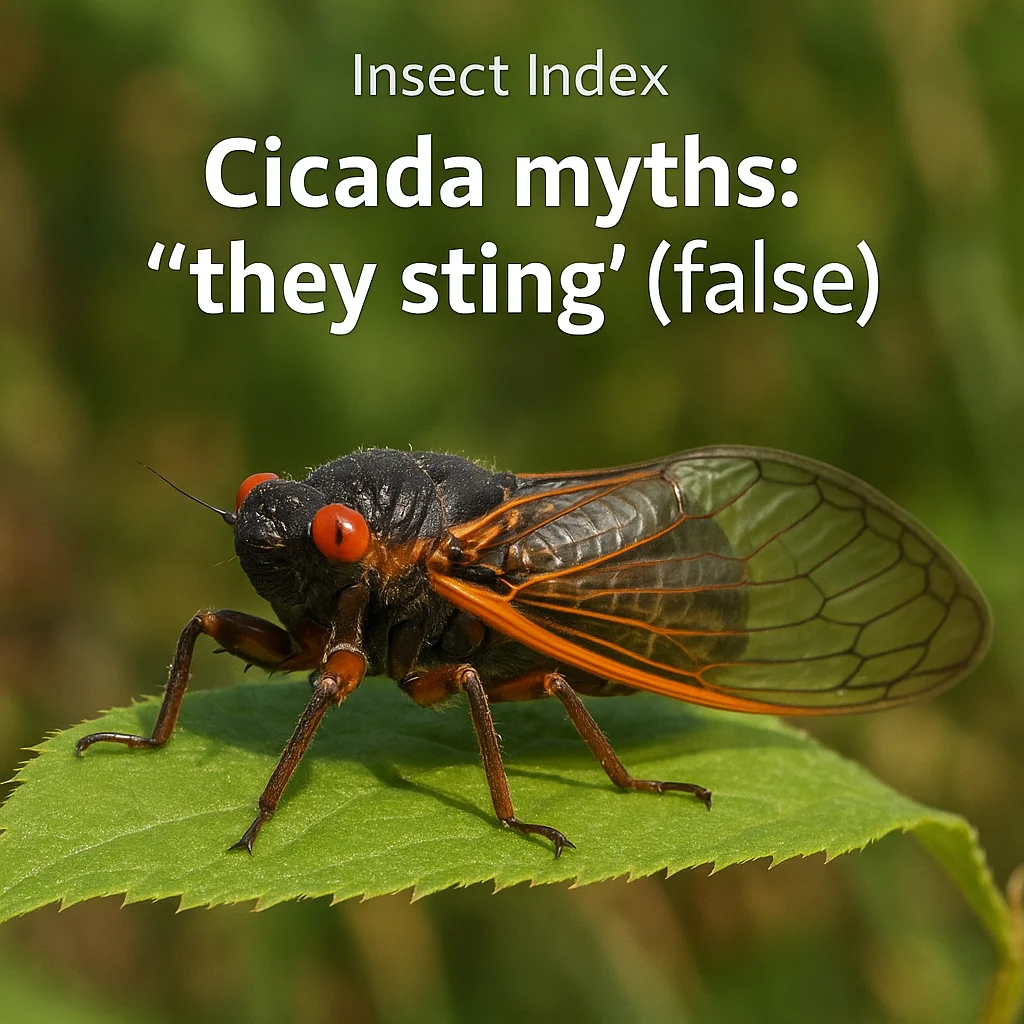
Cicadas are easily identified by their distinctive body shape. They have a robust, wide abdomen and a broad, stubby head with large compound eyes. Their legs, designed for gripping, aid in their singing perches. Cicadas possess short antennae, often inconspicuous against their large bodies.
The wings of a cicada are transparent and membranous, adorned with visible veins. When resting, the wings fold over the body in a tent-like manner. Despite myths, cicadas do not sting or harm humans.
- Robust body with a broad silhouette
- Large, clear wings with prominent veins
- Large compound eyes
- Short antennae
- Distinctive, loud mating call
- Active during the day
🧠 Basic Body Structure
Cicadas have a basic insect body plan comprising three main parts: the head, thorax, and abdomen. They possess six legs, crucial for gripping surfaces and perching on trees. Cicadas, like all insects, have an invertebrate structure, characterized by an exoskeleton that they periodically molt to grow.
The exoskeleton provides protection and support. Cicadas are known for their strong wings, which are essential for their life cycle stages of molting from the nymph to adult phase.
🌍 Habitat & Distribution
Cicadas thrive in a wide variety of habitats including deciduous forests, gardens, and even urban areas with sufficient tree coverage. They are often found living on or below trees and shrubs. Cicadas contribute to the vibrancy of ecosystems from the temperate to tropical regions globally.
Microhabitats for cicadas include living beneath bark and burrowing underground during their nymph stage before emerging as adults.
📅 Seasonal Appearance & Activity
Adult cicadas are typically most visible from late spring through late summer. They are diurnal, with their activities weakening in cooler temperatures. Rain and high humidity can increase their presence, as these weather conditions typically coincide with their emergence periods.
- Late spring to late summer
- Warm, humid days
- Prefer daytime activity
- Best seen in woodlands and gardens
🥚 Reproduction & Egg-Laying
Male cicadas attract females with their distinctive calls. After mating, females lay eggs in slits made in tree bark. A single cicada can lay hundreds of eggs to ensure survival. Once the eggs hatch, the nymphs drop to the ground where they burrow and begin their life underground.
Females exhibit variability in egg-laying based on the geographic region and cicada species. Some species can lay up to 600 eggs in a single season.
🌀 Metamorphosis & Life Cycle
Cicadas undergo incomplete metamorphosis, cycling through egg, nymph, and adult stages. Nymphs live underground for several years, feeding on the sap of tree roots. As they mature, they emerge from the ground to molt one last time into their adult form.
The adult stage is relatively brief compared to their nymph stage, lasting around four to six weeks. During this stage, they focus on reproduction before dying, leaving behind the next generation of nymphs.
🍽️ Diet & Feeding Behavior
Cicadas use piercing-sucking mouthparts to feed on plant sap. In their nymph stage, they subsist on xylem fluids from tree roots. As adults, they remain herbivorous, feeding on sap from various plants.
Their feeding habits have a negligible impact on plants, serving primarily a role in plant growth regulation rather than damage.
🦉 Predators & Defense
Cicadas face numerous natural enemies, including birds, reptiles, amphibians, and various insects such as spiders and parasitic wasps. Their primary defense mechanism includes camouflaged coloration and flying quickly away from threats. Cicadas may also emit loud noise bursts to startle predators.
- Camouflage with surroundings
- Quick flight response
- Loud noises to startle
- Emergence in large numbers to overwhelm predators
👥 Social Behavior & Swarms
Cicadas are generally solitary, except during mating seasons when they gather in large numbers. This group emergence is not a cooperative behavior but rather a survival strategy to overwhelm predators with sheer numbers, known as predator satiation.
🧭 Senses & Communication
Cicadas possess keen auditory senses, using sound as their primary method of communication. Males produce loud, rhythmic calls using specialized organs called tymbals. This sound serves to attract females as well as deter predators.
Vibratory communication complements their acoustic signals, especially during the final stages of courtship.
🌱 Role in the Ecosystem
Cicadas play vital ecological roles, including acting as prey for various predators and contributing to nutrient cycling. As decomposers, their dead bodies enrich the soil. Cicadas aerate the ground during their nymph stage, aiding plant root growth.
While their presence can be beneficial to ecosystems, they rarely have negative impacts on human agriculture.
📉 Population & Conservation Notes
Cicadas are often abundant, given their emergence patterns. However, habitat destruction, pesticide use, and climate changes pose threats to some species. Minimal human interference generally supports their populations well.
- Plant native trees and shrubs
- Reduce pesticide usage
- Protect forested areas and gardens
- Leave leaf litter to support nymphs
⚠️ Human Interaction & Safety
Although they may seem intimidating, cicadas do not sting or pose significant threats to humans. Their piercing-sucking mouthparts are used primarily for feeding on plants, not interaction with humans.
In the rare event of irritation, rinse the affected area and avoid scratching. Seek professional advice if any severe allergic reactions occur.
📌 Summary
- Easily identifiable by body shape and wing features
- Thrives in diverse habitats worldwide
- Most visible in late spring to summer
- Undergoes incomplete metamorphosis
- Feeds on plant sap, harmless to humans
- Preyed upon by birds and other animals
- Plays a crucial role in nutrient cycling
- Safe for human interaction, does not sting