🕷️ How to tell cicadas vs leafhoppers
🧾 Quick Facts
The distinguishing features of cicadas and leafhoppers can sometimes be subtle, but understanding their differences is essential for accurate identification and appreciation of their unique roles in the ecosystem. These two groups of insects are fascinating creatures that have intrigued scientists and nature enthusiasts alike.
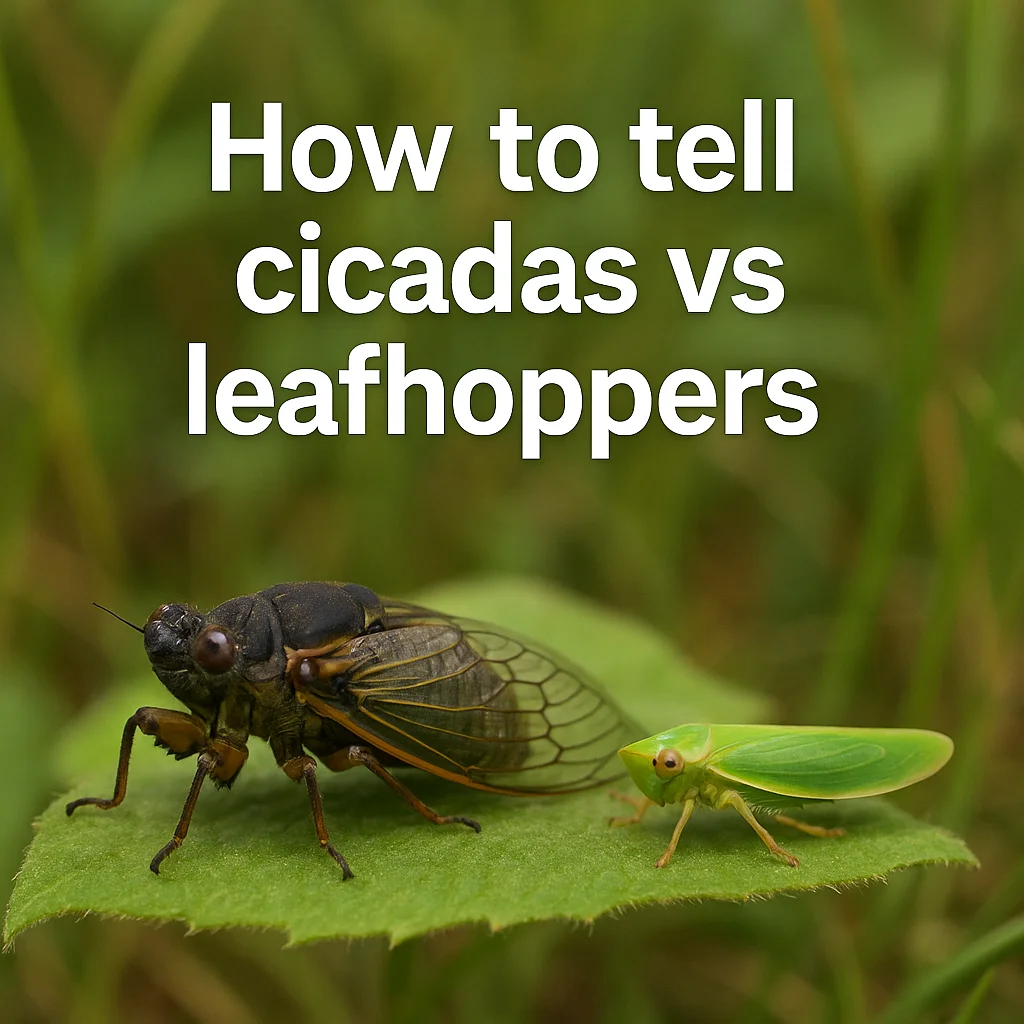
- Common names: Cicadas, Leafhoppers
- Scientific name: Varies
- Insect or not: Both are insects (invertebrates)
- Order / family: Cicadas (Cicadidae), Leafhoppers (Cicadellidae)
- Typical size range (adult): Cicadas 1-1.5 inches (2.5-4 cm), Leafhoppers 0.1-0.5 inches (0.25-1.5 cm)
- Key colors/patterns: Cicadas are often black and green or brown with semi-transparent wings; Leafhoppers vary widely, often with bright colors and patterns
- Activity: Primarily diurnal (active during the day) for both
- Typical habitats: Woodlands, fields, gardens for both
- Where in the world it occurs: Both are widespread; Cicadas mainly in temperate regions, Leafhoppers globally
- Seasonality: Cicadas are mostly seen in late spring to summer; Leafhoppers can be seen in various warm months
🔍 Identification
Cicadas and leafhoppers may look similar at first glance, but a closer look reveals distinct differences. Cicadas generally have sturdy bodies with broad, membranous wings held tent-like over their abdomen when at rest. Their heads are broad, and they possess antennae that are short and bristle-like. Leafhoppers, on the other hand, have slender, wedge-shaped bodies and wings that cover their bodies lengthwise.
The movement styles of these insects also differ. Cicadas are known for their loud buzzing calls and slow, predictable flight patterns. Leafhoppers are agile and abrupt, often seen making quick leaps between plants. They are also typically smaller than cicadas and can easily be overlooked due to their rapid movement and size.
- Top ID Tips:
- Cicadas are generally larger and louder than leafhoppers.
- Cicadas have membranous wings with visible veins; leafhoppers have thicker, more opaque wings.
- Leafhoppers display a wide range of bright colors and patterns.
- Listen for the loud buzzing of cicadas, usually in summer.
- Observe movement: cicadas fly slowly, while leafhoppers jump quickly.
- Cicadas’ eyes are positioned on each side of the head; leafhoppers’ layout can vary.
🧠 Basic Body Structure
Both cicadas and leafhoppers are true insects, possessing the key body segments found in this diverse group: head, thorax, and abdomen. These segments are supported by a hard exoskeleton. Cicadas and leafhoppers both have six legs, characteristic of insects, and they undergo a process known as molting as they grow.
Cicadas are known for their wings, which are large and membranous with prominent vein patterns. Leafhoppers have wings, but they are generally more rigid. As invertebrates, they lack a backbone, which is characteristic of vertebrates. Their bodies are supported and protected by an external skeletal structure, or exoskeleton.
🌍 Habitat & Distribution
Cicadas and leafhoppers inhabit a variety of environments, often being found in woodlands, fields, and gardens. Cicadas are more commonly found in temperate regions, where their calls are a familiar sound of late spring and summer. Leafhoppers, given their wide distribution, can be found globally across numerous habitats ranging from tropical to temperate climates.
Within these environments, they occupy different microhabitats. Cicadas are often found high in trees, whereas leafhoppers prefer staying closer to the ground on grasses or bushes. The presence of these insects tends to be closely linked to the available vegetation.
📅 Seasonal Appearance & Activity
In many regions, cicadas are most visible from late spring to summer. These insects are predominantly active during the day, taking advantage of the daylight to execute their calls which are part of their mating behavior. Leafhoppers, while also primarily diurnal, have a wider range of active months due to their varied habitats.
- Best Time to Spot It:
- Late spring to summer is ideal for cicadas.
- Leafhoppers are more plentiful during warmer months.
- Both are more visibly active in dry, warm weather.
- Look for cicadas in treetops and leafhoppers on vegetation.
🥚 Reproduction & Egg-Laying
Cicadas have a fascinating lifecycle that includes a prolonged underground development period. After mating calls successfully attract females, eggs are laid into tree branches or twigs. Eggs hatch into nymphs that fall to the ground and burrow, living underground for the majority of their lifecycle.
Leafhoppers have a different strategy. Eggs are typically laid on or within plant tissues, and the juvenile nymphs resemble small, wingless adults. Egg-laying and nymph stages can vary significantly depending on the specific leafhopper species.
🌀 Metamorphosis & Life Cycle
Cicadas undergo incomplete metamorphosis, progressing from egg to nymph to adult. Cicada nymphs spend years underground feeding on root sap, emerging in the summer of their final year to molt into winged adults. Nymphal development time can vary significantly by species, ranging from a few years for annual species to over a decade for periodical cicadas.
Leafhoppers also undergo incomplete metamorphosis. Their nymphs develop through several instars before maturing into adults. Feeding on plant juices, nymphs are typically found on the same plants as their adult forms.
🍽️ Diet & Feeding Behavior
Both cicadas and leafhoppers feed primarily on plant fluids but employ different methods. Leafhoppers possess piercing-sucking mouthparts adapted for extracting sap from plants. This feeding can make them significant agricultural pests as they can spread plant diseases.
Cicadas, particularly during their nymphal stage, feed on the root sap of trees and shrubs. As adults, they continue to feed on plant sap but in much smaller quantities. Their role as herbivores does not typically cause significant damage to plants.
🦉 Predators & Defense
Cicadas and leafhoppers serve as prey for numerous bird species, reptiles, and small mammals. Additionally, predation comes from spiders, predatory insects, and parasitoid wasps. Cicadas utilize camouflage with cryptic coloring to blend into their environment.
Leafhoppers, owing to their small size and active hopping, are agile and can escape potential dangers. Both groups contribute to food webs, playing integral roles in their habitats.
- Defense Highlights:
- Cicadas use cryptic coloring for camouflage.
- Leafhoppers rapidly jump away from threats.
- Both have rigid exoskeletons providing some protection.
- Cicadas are often overlooked due to being high in the trees.
👥 Social Behavior & Swarms
Cicadas are not social insects in the manner of bees or ants, but they are gregarious, often emerging as large groups or 'broods' in certain years. Although not organized in social colonies, their synchronized emergence can resemble swarm behavior.
Leafhoppers are generally solitary, although they can appear in high numbers in suitable habitats. Their movements are typically individual, but habitat patches can result in high localized populations.
🧭 Senses & Communication
Cicadas are renowned for their acoustic communication, employing specialized organs called tymbals to produce their characteristic sounds. These sounds function primarily in mating calls to attract females. Their vision is adapted to their environment, with large prominent eyes.
Leafhoppers do not utilize sound to the same extent but are believed to communicate through vibrations transmitted through plants. Chemotaxis through pheromones plays a role in both groups for purposes such as mating.
🌱 Role in the Ecosystem
Both cicadas and leafhoppers play essential roles in their ecosystems. Cicadas contribute to nutrient cycling; their nymphs aerate soil, and they provide a food source for numerous predators. Leafhoppers play roles in pollination and act as both food sources and vectors for plant pathogens.
Although they can have impacts on agriculture when abundant, especially leafhoppers due to their vectoring abilities, they are important in maintaining ecological balance.
📉 Population & Conservation Notes
Generally, both cicadas and leafhoppers are common in suitable habitats. However, their populations are affected by habitat changes such as deforestation and the use of pesticides. Climate change may also alter their distributions slightly over time.
- How to Help (Low-Impact):
- Plant native vegetation to support their lifecycle.
- Avoid harsh pesticides that can disrupt populations.
- Create wildlife-friendly garden spaces.
- Leave leaf litter undisturbed where possible.
⚠️ Human Interaction & Safety
Neither cicadas nor leafhoppers are harmful to humans, as they do not bite or sting. While their presence in trees and gardens can be noted with awe or mild annoyance (especially in the case of loud cicadas), it is essential to appreciate their ecological roles. If individuals cause concern, general advice is to observe them respectfully and not interfere or collect them unnecessarily.
📌 Summary
- Cicadas and leafhoppers are distinct but often confused due to some superficial similarities.
- They inhabit various natural environments, often found in forests and gardens worldwide.
- Most visible during warmer months, especially in temperate regions.
- Cicadas have an extended, often complex life cycle, while leafhoppers develop quickly.
- Both feed on plant fluids, using specialized mouthparts.
- Predators include birds, reptiles, and insects, with camouflage contributing to defense.
- Ecological roles include pollination and pest control, with wider ecosystem benefits.
- Conservation practices can aid in maintaining their populations.