🕷️ Shield bugs vs leaf-footed bugs: quick ID
🧾 Quick Facts
Shield bugs and leaf-footed bugs are often mistaken for each other due to their similar body shapes and habitats. However, they belong to different families and have distinguishing features. These bugs, commonly found in gardens and forests worldwide, are crucial for understanding biodiversity.
- Common names: Shield bug, stink bug, leaf-footed bug, squash bug
- Scientific name: Varies, with different species in families like Pentatomidae (shield bugs) and Coreidae (leaf-footed bugs)
- Insect or not: Yes, they are insects and members of the order Hemiptera
- Order / family: Hemiptera / Pentatomidae & Coreidae
- Typical size range: 12 to 20 millimeters (adult)
- Key colors/patterns: Green, brown, mottled with distinctive patterns
- Activity: Diurnal (active during the day)
- Typical habitats: Gardens, forests, fields, urban areas
- Where in the world it occurs: Global distribution, from temperate to tropical regions
- Seasonality: Most visible in spring and summer
🔍 Identification
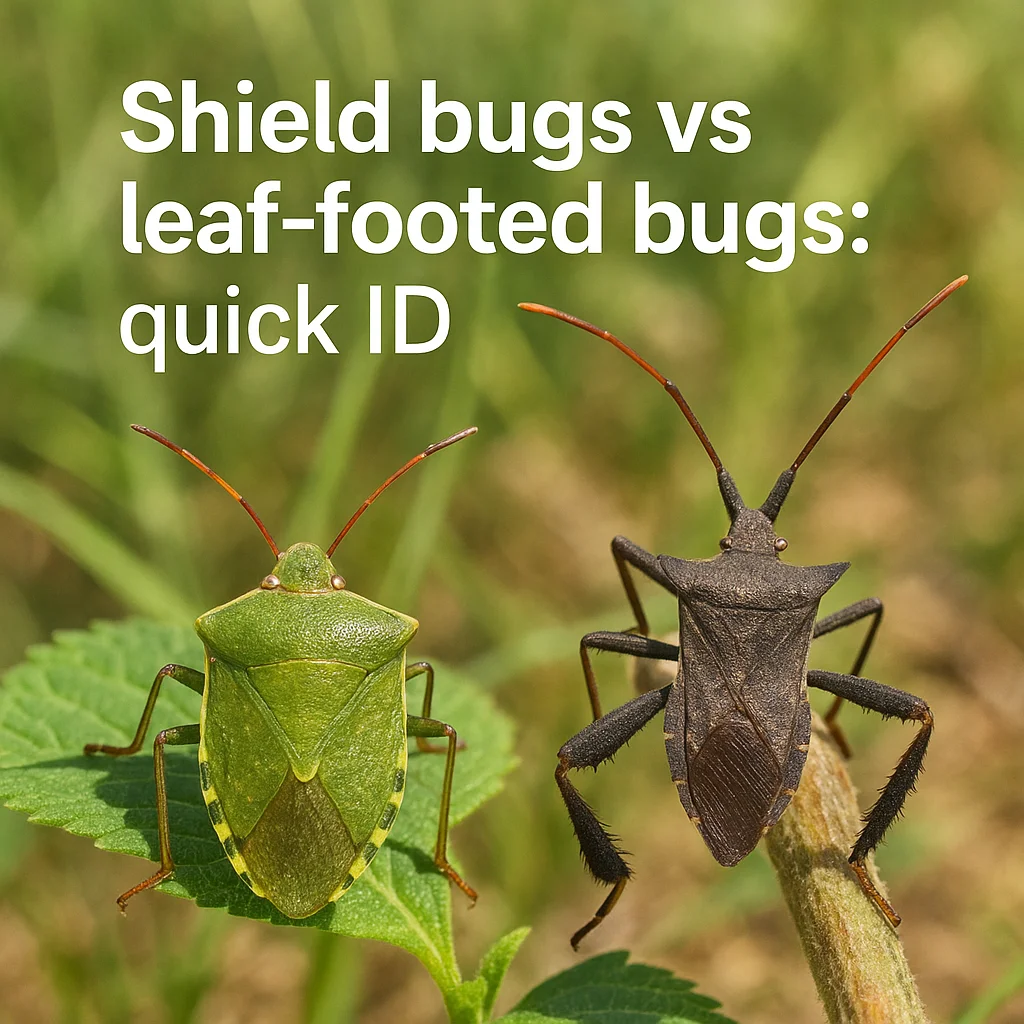
Identifying shield bugs and leaf-footed bugs can be straightforward if you know what to look for. Both have distinctive body shapes, with shield bugs typically more rounded and leaf-footed bugs having hind legs with leaf-like expansions.
- Body shape and silhouette: Shield bugs have a shield-shaped body, while leaf-footed bugs are more elongated with leaf-like structures on their hind legs.
- Antennae type: Both have long, segmented antennae.
- Wing features: Shield bugs have wings that form a triangular shape on their backs, whereas leaf-footed bugs have membranous, overlapping wings.
- Leg traits and movement style: Leaf-footed bugs exhibit leaf-like expansions on their hind legs, aiding in mimicking leaves for camouflage.
- Distinguishing look-alikes and common confusion: Most confusion arises with other Hemiptera such as assassin bugs, which usually have thinner bodies and are predatory.
- Top ID Tips:
- Look for shield shape in shield bugs
- Check for leaf-like leg expansions in leaf-footed bugs
- Observe wing patterns and their arrangement
- Note color variations and patterns
- Compare body silhouettes
- Check antennae length and segmentation
🧠 Basic Body Structure
Shield bugs and leaf-footed bugs, like all insects, have a three-part body plan: head, thorax, and abdomen. Each insect has six legs and an exoskeleton that it periodically sheds through molting. They possess wings that aid in flight and movement.
These bugs are invertebrate creatures, meaning they lack a spinal column, a common trait among insects.
🌍 Habitat & Distribution
Shield bugs and leaf-footed bugs thrive in diverse environments such as gardens, agricultural fields, forests, and urban areas. They can be found on plants, under leaves, and near flowers where they feed and lay eggs. Their geographic range includes most continents, favoring temperate to tropical climates.
Habitat alterations, such as agriculture expansion and urbanization, can influence where these bugs are commonly seen. In urban gardens, they are often attracted to ornamental and vegetable plants.
📅 Seasonal Appearance & Activity
These bugs are typically observed from spring through summer, coinciding with the growth of their host plants. As they are diurnal insects, they are most active during the day and are influenced by warm and dry weather conditions.
- Best Time to Spot It:
- Late spring to early summer
- Warm, sunny days
- Early mornings and late afternoons
- Avoiding rainy or overly windy conditions
🥚 Reproduction & Egg-Laying
Mating behavior for these insects involves courtship rituals that vary among species, often including pheromone signaling. Eggs are laid in clusters, usually on the underside of plant leaves, with a few dozen to a hundred eggs in each batch. The eggs are small, oval, and sometimes colored to blend with foliage.
🌀 Metamorphosis & Life Cycle
Shield bugs and leaf-footed bugs undergo incomplete metamorphosis, progressing from egg to nymph to adult. Nymphs resemble smaller, wingless versions of adults, undergoing multiple molts to reach maturity.
Throughout their life stages, they primarily feed on plant juices, utilizing specialized mouthparts for piercing and sucking. Nymphs and adults inhabit similar environments, often remaining on host plants where they were hatched.
🍽️ Diet & Feeding Behavior
Both shield bugs and leaf-footed bugs are herbivores. They feed on a wide array of plants, including crops and ornamental garden flora. Their piercing-sucking mouthparts allow them to extract plant juices efficiently.
As herbivores, they play a role in regulating plant populations, although they may cause damage to crops during infrequent population surges.
🦉 Predators & Defense
Natural enemies include birds, spiders, small mammals, and parasitoid wasps. To defend themselves, these bugs use different strategies such as camouflage, releasing foul-smelling chemicals, and dropping from plants in a startle response.
- Defense Highlights:
- Camouflage with plant surroundings
- Release of unpleasant odors
- Quick, erratic movements
- Dropping to ground when disturbed
👥 Social Behavior & Swarms
Shield bugs and leaf-footed bugs are generally solitary, although they can occasionally be seen feeding together when populations are high. While these insects do not form swarms, their dense presence during favorable conditions can make it seem as though they are more social.
🧭 Senses & Communication
These bugs rely heavily on their sense of smell, using pheromones for communication. Sight is also vital, with compound eyes helping detect movement and changes in light. Sound and vibration help them sense predators and communicate within close range.
Pheromone communication is essential in mating, with release patterns varying across species.
🌱 Role in the Ecosystem
Shield bugs and leaf-footed bugs contribute to their ecosystems as both prey and herbivores. They help sustain predator populations, and by controlling plant growth, they maintain local plant communities. In some spots, they serve as biocontrol agents for invasive plants.
While sometimes considered pests for feeding on crops, their ecological roles emphasize the importance of balanced pest management strategies.
📉 Population & Conservation Notes
The population status of these insects varies by region, influenced by factors like habitat loss, climate change, and pesticide use. They often adapt well to changing conditions, making them commonly abundant in suitable environments.
- How to Help (Low-Impact):
- Plant native flora to provide natural habitats
- Minimize pesticide usage in gardens
- Preserve leaf litter as microhabitats
- Encourage biodiversity in green spaces
⚠️ Human Interaction & Safety
Neither shield bugs nor leaf-footed bugs pose significant threats to humans. They do not bite or sting, but their release of foul odors when disturbed can be unpleasant. If handling is necessary, gloves can be used to avoid the odor.
For the most respectful and safe interaction, observe these insects without attempting to handle or capture them from their natural environments.
📌 Summary
- Quick ID Tips highlight shield vs. leaf-footed shapes
- Habitat spans gardens, forests, and urban areas globally
- Visible during warm days in spring/summer
- Incomplete metamorphosis with egg to adult stages
- Herbivore diet on various plant species
- Predation by birds, spiders, and wasps
- Ecologically important for plant and predator populations
- Respectful and non-intrusive observation recommended