🕷️ Stink bugs: why they smell
🧾 Quick Facts
Stink bugs are known for their unique odor, which they emit as a defense mechanism. While the group is diverse, members are often recognized by their distinct shape and scent.
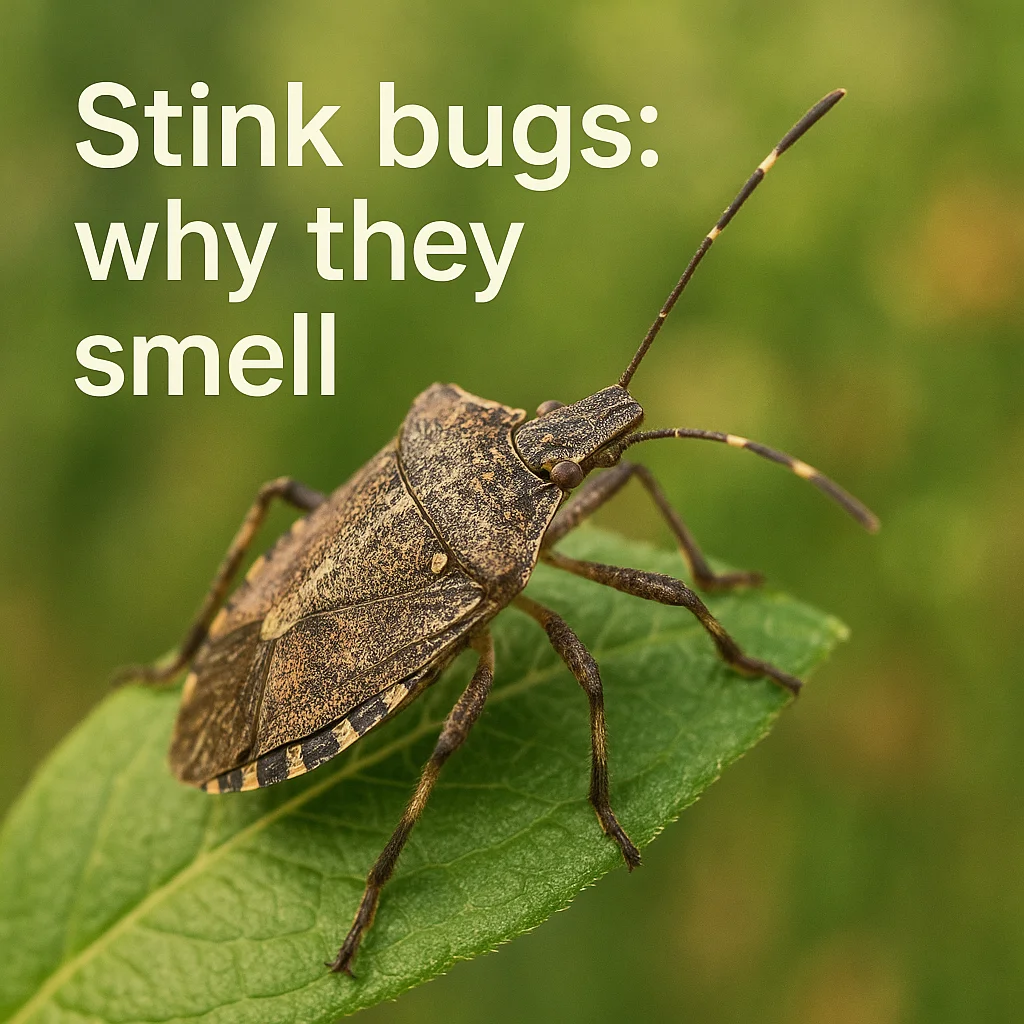
- Common Names: Stink bugs, Shield bugs
- Scientific Name: Varies
- Insect or Not: Insect, as they are invertebrates with a distinct three-part body plan
- Order / Family: Hemiptera / Pentatomidae
- Typical Size Range: 12–18 mm for adults
- Key Colors/Patterns: Brown, green, or mottled patterns
- Activity: Diurnal
- Typical Habitats: Gardens, fields, forests
- Where in the World: Found globally, especially in temperate climates
- Seasonality: Most visible in late spring to early fall
🔍 Identification
Stink bugs feature a distinct shield-shaped body that tapers towards the head and is broad at the thorax. Their antennae are often segmented and prominent. The wings are held flat over the body, creating an "X" formation when viewed from above. They have robust legs that aid in their characteristic slow, deliberate movement.
Look-alikes include other types of shield bugs or beetles, but stink bugs can be distinguished by their flattened, shield-like profile and the characteristic smell they produce when threatened.
- Top ID Tips:
- Shield-shaped body
- Segmented antennae
- Wings with an "X" pattern
- Slow, deliberate movement
- Characteristic odor when disturbed
- Brown or green coloration
- Entire insect visible in identification photos
- Notable triangular plate on back (scutellum)
- Bulging eyes on either side
- Entire specimen visible in frame
🧠 Basic Body Structure
Stink bugs, like other insects, have a basic body plan that includes a head, thorax, and abdomen. They have six legs and an exoskeleton that protects their body and requires them to molt as they grow. Some have wings that aid in their movement.
The stink bug is an invertebrate, meaning it lacks a backbone. This structural trait is typical for insects, contributing to their great diversity and adaptability.
🌍 Habitat & Distribution
Stink bugs are commonly found in a variety of environments, favoring gardens, fields, forest edges, and sometimes urban areas. They may dwell under leaves, among foliage, or in cracks and crevices. They thrive in temperate regions but are adaptable to a wide range of climates, influencing where and when they can be spotted.
Their presence is often dictated by the availability of host plants and can change with environmental conditions and agricultural practices.
📅 Seasonal Appearance & Activity
Stink bugs are most noticeable in spring through fall, being diurnal and therefore most active during day hours. Their appearance is influenced by temperature, as warmer conditions can increase their activity and encourage breeding.
- Best Time to Spot It:
- Late spring to early fall
- Sunny, warm days
- Early morning or late afternoon
- After mild rainfall
- In and around gardens with host plants
- Calm weather conditions
🥚 Reproduction & Egg-Laying
Stink bugs engage in simple courtship behaviors and do not maintain territories. Eggs are typically laid on the underside of leaves in clusters, providing protection from predators. The number of eggs varies, generally ranging between 20 to 80 per laying.
Females select plants that offer ample food sources for emerging nymphs, which contributes to their survival and the rapid growth of populations.
🌀 Metamorphosis & Life Cycle
Stink bugs undergo incomplete metamorphosis, transitioning through egg, nymph, and adult stages.
Egg Stage: Eggs are deposited on plants, hatching within a week to ten days depending on temperature.
Nymph Stage: Nymphs resemble small adults but lack wings. They feed on plant sap, undergoing several molts over weeks.
Adult Stage: After final molting, adults develop wings and reproductive capabilities, seeking mates and host plants.
🍽️ Diet & Feeding Behavior
Stink bugs primarily feed using piercing-sucking mouthparts, drawing sap from plants, which can sometimes damage crops. They may exhibit opportunistic feeding behavior when other food sources are scarce.
As herbivores, their diet largely consists of fruiting plants, seeds, and sometimes smaller insects, impacting both plant health and population dynamics in their ecosystems.
🦉 Predators & Defense
Stink bugs have various natural predators, including birds, spiders, and small mammals. They employ several defensive strategies to deter these threats, including their notorious odor, which serves as an effective deterrent.
Their hard exoskeleton offers some protection against physical threats, and their ability to drop from plants when disturbed helps them avoid capture.
- Defense Highlights:
- Emits strong odor when threatened
- Hardened exoskeleton
- Camouflaged coloration
- Dropping behavior to avoid predators
- Slow deliberate movement aids in blending with the environment
👥 Social Behavior & Swarms
Generally solitary, stink bugs occasionally display social behavior if multiple individuals are attracted to suitable food sources. They do not form colonies but may aggregate seasonally during migration or breeding times.
Large numbers in a single area often result from ideal conditions that attract individuals independently, rather than organized swarming behavior.
🧭 Senses & Communication
Stink bugs utilize a strong sense of smell to locate food and mates, relying on pheromones for communication. This method allows them to coordinate behaviors such as mating and aggregation effectively across distances.
They may also use touch and vibrations to perceive their environment, responding to changes in light and movement around them.
🌱 Role in the Ecosystem
Stink bugs play important roles in their ecosystems, including both pest and beneficial insect relationships. They help control certain plant species by feeding on them, and also serve as prey for various predators, contributing to the food web.
Their interactions with plants can be both beneficial, through pollination and natural control, and detrimental, when they damage crops and ornamental plants.
📉 Population & Conservation Notes
Stink bugs are often common in suitable habitats, though population dynamics can be affected by agriculture, climate change, and urban sprawl. The availability of host plants influences their populations, which may fluctuate seasonally or annually.
- How to Help (Low-Impact):
- Plant native vegetation in gardens
- Avoid broad-spectrum pesticides
- Encourage natural predator presence
- Leave leaf litter and debris for microhabitats
- Use barrier methods to exclude them from homes
⚠️ Human Interaction & Safety
Stink bugs are generally harmless to humans and do not bite or sting. However, large infestations can be a nuisance, and the odor they release can be unpleasant.
If encountered indoors, gently removing them outdoors is recommended. Wash hands after contact, and seek professional advice if adverse reactions occur due to allergies.
Encouraging observation rather than collection helps maintain safe and respectful interactions with these insects.
📌 Summary
- Stink bugs are known for their shield-shaped bodies and distinct smell.
- They inhabit gardens, fields, and forest areas across the globe.
- Active during the day, especially from spring to fall.
- Undergo incomplete metamorphosis: egg, nymph, and adult stages.
- Primarily herbivores, feeding on plant sap with piercing-sucking mouthparts.
- Predators include birds and mammals; defense strategies involve emitting odor.
- Serve as both pest and prey in ecosystems.
- Common in suitable habitats but influenced by environmental changes.
- Harmless to humans; nuisance is mainly odor-related.