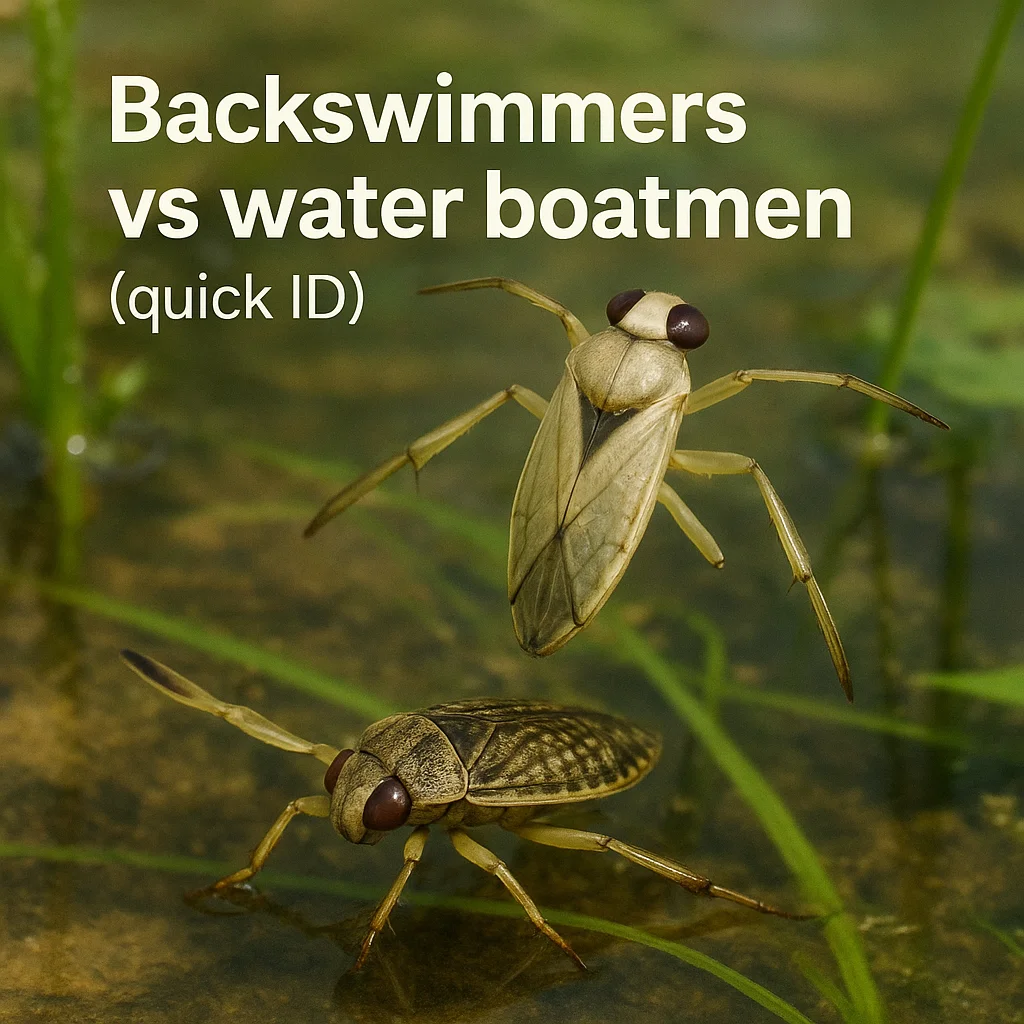
🕷️ Backswimmers vs water boatmen (quick ID)
🧾 Quick Facts
Backswimmers and water boatmen are common aquatic insects often mistaken for each other due to their similar habits and habitats. However, with a closer look, they are quite distinct. Here's a quick breakdown of their key features:
- Common names: Backswimmers, water boatmen
- Scientific name: Varies (family Notonectidae for backswimmers, Corixidae for water boatmen)
- Insect or not: Insects (invertebrates)
- Order / family: Hemiptera / Notonectidae and Corixidae
- Typical size range: 1.5–2 cm (adult)
- Key colors/patterns: Pale gray or brown; backswimmers often have a lighter, more silvery hue
- Activity: Mostly diurnal
- Typical habitats: Freshwater ponds, lakes, slow streams
- Global occurrence: Worldwide, except polar regions
- Seasonality: Spring to autumn
🔍 Identification
Despite sharing similar habitats, backswimmers and water boatmen can be distinguished through several identification cues. Here’s how to recognize them in the field:
- Body shape and silhouette: Backswimmers have a streamlined, boat-shaped body that is convex on the dorsal side, allowing them to swim upside down. Water boatmen, on the other hand, have a more flattened body that allows for effective bottom scraping and swimming.
- Antennae type: Both have short, hidden antennae, often not visible without close examination.
- Wing features: Both have wings; backswimmers have a more prominent x-shaped pattern when wings are folded.
- Leg traits and movement style: Backswimmers have long, fringed hind legs adapted for powerful swimming, whereas water boatmen have shorter, oar-like appendages designed for paddling.
- Distinguishing look-alikes: Backswimmers swim on their backs with their belly facing upward, while water boatmen swim upright.
- Look for backswimmers swimming upside down.
- Water boatmen often rest under the water's surface, appearing flat.
- Backswimmers have longer back legs compared to water boatmen.
- Water boatmen exhibit a dusty, brown coloration, aiding them in camouflage.
- Check for the pearly luster on backswimmers' back.
- Water boatmen tend to be more docile and less inclined to bite.
🧠 Basic Body Structure
As insects, both backswimmers and water boatmen have a basic body plan common to their order:
- Head: Equipped with piercing-sucking mouthparts.
- Thorax: Connects to three pairs of legs and two pairs of wings, functional in adults.
- Abdomen: Houses reproductive organs and features aids in buoyancy.
- Exoskeleton: Provides protection and structural support, requiring molting for growth.
- Six legs: Essential for swimming and movement in their aquatic habitat.
- Wings: Present, aiding in travel between water bodies.
- Invertebrate: Lacks a spine, relying on its exoskeletal framework.
🌍 Habitat & Distribution
Both backswimmers and water boatmen are found in a variety of freshwater habitats worldwide, preferring slow-moving or still waters:
- Preferred environments: Found in ponds, lakes, slow streams, and wetlands.
- Microhabitats: Occupy regions under vegetation, along the water's edge, or amid floating debris.
- Geographic range: Present on every continent except Antarctica, thriving in temperate and tropical climates.
📅 Seasonal Appearance & Activity
Both backswimmers and water boatmen are most active and visible during specific times, influenced by seasonal and diurnal changes:
- Months/seasons: Spring through autumn in temperate regions.
- Time of day: Primarily diurnal, though some activity continues during early evening.
- Weather influences: High activity noted during warm, sunny conditions.
- Spring and summer are prime viewing seasons.
- Look for them in full sunlight, when they are near the water surface.
- Reduced activity during cooler months.
- Active in calm weather, with limited activity during storms.
🥚 Reproduction & Egg-Laying
Both groups engage in fascinating reproductive behaviors with some notable distinctions:
- Mating behavior: Involves courtship displays and mate selection, varying across species.
- Egg-laying sites: Females usually lay eggs underwater on submerged plant surfaces or floating vegetation.
- Egg counts: Can vary widely, often ranging from a few to several hundred per female, depending on the species and environmental conditions.
🌀 Metamorphosis & Life Cycle
Both backswimmers and water boatmen undergo incomplete metamorphosis, characterized by the following stages:
- Egg: Deposited in water; hatches into nymphs.
- Nymph: Resembles smaller versions of adults; lacks wings and undergoes several molts.
- Adult: Gains full wings, becomes reproductively mature, continuing for several weeks to months.
- Diet during stages: Mainly consists of small aquatic organisms and detritus.
🍽️ Diet & Feeding Behavior
Both insects have predatory and scavenging roles, featuring distinct mouthparts for their diet:
- Feeding tools: Piercing-sucking mouthparts for ingesting the bodily fluids of prey.
- Dietary range: Includes algae, plant matter (more common for water boatmen), and small aquatic animals (predatory role in backswimmers).
- Role: Acts as both herbivores (water boatmen) and predators (backswimmers), depending on the availability of food sources.
🦉 Predators & Defense
Backswimmers and water boatmen encounter various natural enemies and employ several defenses:
- Natural enemies: Birds, fish, and amphibians are common predators.
- Defense strategies: Include camouflage through color adaptation, rapid swimming to escape, and for backswimmers, the use of painful bites as a deterrent when threatened.
- Camouflage with water and vegetation.
- Fast, agile swimming patterns.
- Ability to quickly submerge when threatened.
- Painful bite in backswimmers as a deterrence.
👥 Social Behavior & Swarms
These aquatic insects are primarily solitary, though environmental factors can lead to temporary congregation:
- Territorial behaviors evident during mating periods.
- Mating encounters may lead to temporary pair formations.
- No organized social structures or colonies in either group.
🧭 Senses & Communication
Despite their small size, backswimmers and water boatmen have developed acute senses suited for aquatic life:
- Vision: Well-developed compound eyes for detecting movement and light intensity.
- Smell/pheromones: Less prominent compared to terrestrial insects.
- Sound/vibration: Can sense vibrations in the water, aiding in predator avoidance and prey detection.
🌱 Role in the Ecosystem
Both species play vital roles in aquatic ecosystems:
- Ecological importance: Aid in controlling populations of smaller aquatic organisms and contribute to the breakdown of organic material.
- Mutual relationships: Some species engage in mutualistic interactions with aquatic plants.
📉 Population & Conservation Notes
The general abundance of both backswimmers and water boatmen reflects their adaptability, though they face challenges:
- Habitat loss: Urbanization and pollution lower their suitable habitats.
- Conservation: Considered common, though local populations can vary widely.
- Encourage native plant growth near water bodies.
- Avoid chemical pollution in aquatic environments.
- Preserve natural habitats and avoid draining wetlands
- Educate others about water insect conservation.
⚠️ Human Interaction & Safety
Interaction with these insects is generally safe, though backswimmers can bite if handled:
- Backswimmers may deliver a painful bite if threatened; avoid handling them with bare hands.
- Water boatmen are harmless and less inclined to bite.
- For any severe reaction from an insect bite, seek professional help.
- Observe these creatures respectfully and avoid capturing them from their natural habitats.
📌 Summary
- Backswimmers swim upside down, while water boatmen swim right side up.
- Both are found in diverse freshwater habitats worldwide.
- Most active during warm months and in full sunlight.
- Undergo incomplete metamorphosis; life cycle varies.
- Diet includes algae, aquatic insects, and detritus.
- Natural predators include birds and fish; both have effective defenses.
- Play important ecological roles in aquatic ecosystems.
- Generally common, though sensitive to habitat changes.
- Handling backswimmers can result in bites; observe them safely.